• Skip to primary navigation
  • Skip to main content
  • Skip to primary sidebar

Jackie Van Nice

E-Learning Goodness by Jackie Van Nice

  • Home
  • About
  • Blog
  • Portfolio
    • Articulate’s ELH Challenges
    • Sales Mobility Software
    • Product Sales
    • Sexual Harassment
    • Code of Conduct
  • Freebies
    • Free Storyline Templates
    • Free PowerPoint Templates
    • Free Images
    • Freelancing Tips
    • Free Resources to Help Get Started in eLearning
  • Work With Me
  • Contact

Motivation

Storyline 1 to 2: Passport Makeover Edition

June 24, 2015 By Jackie Van Nice 13 Comments

Select Image to Launch (New) Demo

Select Image to Launch (New) Demo

I was always fond of this little passport how-to I did in Storyline 1, but when Articulate was kind enough to feature it on their E-Learning Examples page recently and people seemed to like it – it got me thinking about how I could update it using Storyline 2’s great features.

Navigation: Before & After

Before: A Tab-Based Layout

Before: A Tab-Based Layout

After: A Paris-Bound Jet Guides You

After: A Paris-Bound Jet Guides You

One of my favorite features in Storyline 2 is the slider for its ease of use and power to deliver a lot of information in a compact way.

I knew it would be perfect to get the entire application on one screen where the user could see everything from a high-level overview to a mid-level peek to detailed animations showing how to fill it out – simply by sliding the Paris-bound jet down the runway.

The thing is, you could still create this basic design in Storyline 1 (using this layout for a more compact presentation and navigating via clicking or tapping) – but there’s something about the slider that makes things like this easier to ideate, create, and (on the learner end) use.

Updated Animations

John Hancock Would Be Proud of the Signature Animation

John Hancock Would Be Proud of the Signature Animation

The other feature-based update I made was to the animations. In the original I relied on a fade animation to bring in handwriting and typing, but being able to use the new built-in wipe animation improved the look and feel quite a bit, so I was happy about that.

See the Jet-On-the-Runway Slider!

Here’s the updated jet-fueled slider demo, and here’s the original demo for comparison. Enjoy – and bon voyage!

Filed Under: E-Learning Tagged With: Articulate Storyline, Characters, Context, Design Makeover, E-Learning Design, ELHChallenge, Instructional Design, Motivation, Show Your Work, Visual Design

Learning to Spend Money the Yummy Way

November 17, 2014 By Jackie Van Nice 12 Comments

Select Image to Launch Demo

Select Image to Launch Demo

This week’s Articulate challenge is to create a learning game for kids. What’s not to like about this one?

Grandma's Got Some Money

Grandma’s Got Some Money

The Idea

The only problem was coming up with an idea. I messed around with math and word games, then starting building a camping game, but wasn’t happy with any of it.

I finally realized that unless the game emulated a situation where a kid really needed to apply some knowledge, I wasn’t going to like it and neither would the kid. This scenario reminds me of my wonderful brother Bryan who was always finding treasures and wondering if he had enough money to buy them, but it applies to any kid – large or small.

Flat, Mobile-Friendly, Kid-Friendly Design

Flat, Mobile-Friendly, Kid-Friendly Design

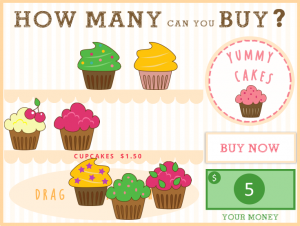
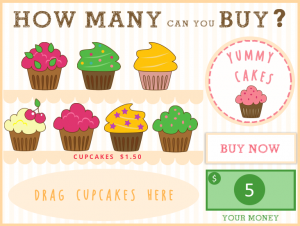
The Interaction

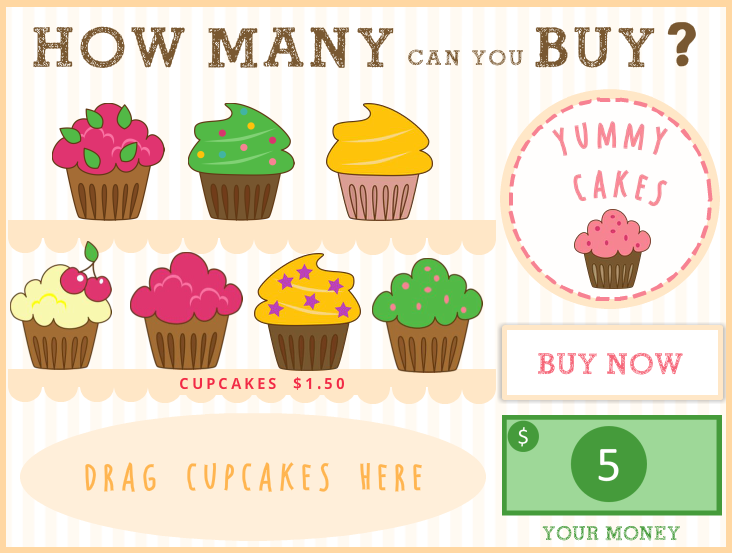
The Intro: I wanted to ease you into the situation rather than unceremoniously drop you at a cupcake shop. Grandma supplies the money and the mission. The rest is up to you.

The Design: I kept the design pretty flat. I also wanted it to be playable on a tablet, so kept it simple and clean. Using a drag-and-drop, avoiding hover states, and keeping images large enough to easily tap and move with fingers were also part of my mobile-friendly plan.

The Challenge: I didn’t want there to be an on-screen calculator that showed how much money would be left after each cupcake was chosen. Those don’t exist in real cupcake shops, so why supply one here?

My Wish List: What I would love to do is supply feedback that goes over the math of what they just spent and ask them how much change they have left. I’d also love to make it so that if they chose to spend a smaller amount – buying just one cupcake, for example – they could save that money and take it with them to the next challenge. I’d want them to go to the movies, a fast food restaurant, an arcade, etc., and be met with different challenges in each location.

Too Much to Mention: There’s lots more that went into this one – from the variables and conditional triggers to the images, fonts, and pictograms – but if I go into all that we’d just be burning daylight, and you need to go buy some cupcakes! (But feel free to ask me questions.)

Go Buy Cupcakes!

Have fun spending Grandma’s money on a little cake and frosting right here.

Select Image to Launch Demo

Select Image to Launch Demo

Filed Under: E-Learning Tagged With: Articulate Storyline, Characters, Community, Context, E-Learning Design, ELHChallenge, Emotional Engagement, Games, Instructional Design, Motivation

At Last! A Drinking Game I Can Win

February 27, 2014 By Jackie Van Nice 10 Comments

At Last! A Drinking Game I Can Win

Select Image to Launch Demo

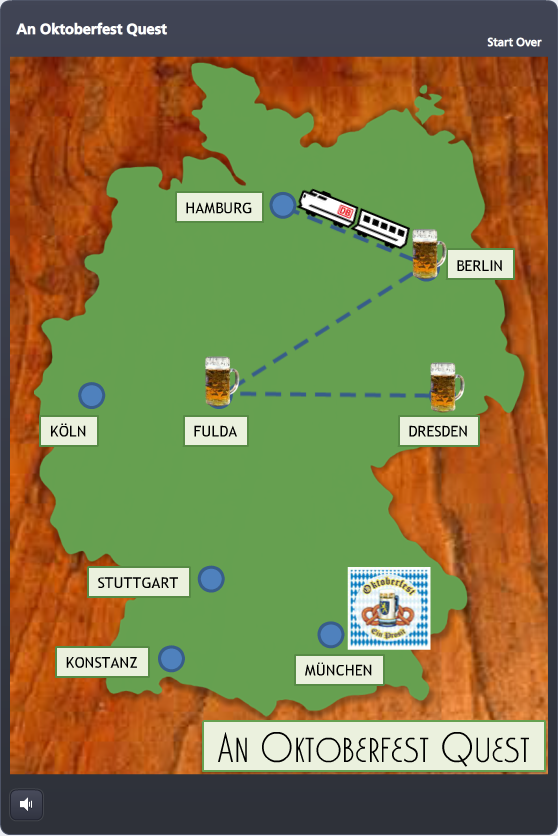
For this week’s Articulate E-Learning Heroes Challenge, David Anderson dared us to create a simple game. (Oh, it’s on.) I created an Oktoberfest Quest game, wherein our hero drinks his way across Germany in order to reach the hallowed beer tents of Oktoberfest in Munich. Somebody had to do it.

A Triumvirate of Inspiration

Timing: David put out the challenge only hours after I’d participated in the weekly #lrnchat discussion on Twitter. Everyone was terribly serious as they discussed how to work collaboratively in groups – until someone brought up beer as a motivational tool. Well, THAT got them dancing in the Twittery aisles, and the whole evening changed. I don’t drink much, but I made a large mental note of what got them engaged: The mere mention of beer.

Topic: As they say, go with what you know. After collecting entirely too many degrees in German, teaching German, and studying, working, and living in Germany – I thought to myself: “maaaaaybe something German…?”

Potential Game Features: I wanted to focus on designing a game board and some sort of progress meter. Since a map of Germany seemed like a natural game board, and a giant Maßkrug slowly filling with beer seemed like an outstanding progress meter, I decided to try those.

Maßkrug

Maßkrug

Design

Since my primary elements, the map of Germany and the Maßkrug, were better suited to a portrait orientation, I flipped the standard Storyline layout so they could inhabit the full screen.

Once I decided to use the game to teach German dining customs, I put a wooden background underneath the map to evoke the feel of a restaurant table, and the checkered tablecloth behind the Maßkrug for the same reason.

I also knew that sound effects would be critical, especially for filling the Maßkrug. I got lucky and found some evocative ones.

Progress

There are two measures of progress: linear progress on the map, and liquidy beer progress in the Maßkrug.

Linear Progress

Linear Progress

Linear Progress: I thought a little Krug at each completed stop on the map would be a good tracker, and moving by train would make it feel like you’re making game progress, and also evoke the sense of traveling through Germany.

At each stop I used a zoom region to zoom in tightly on the city, and then an immediate “Box Out” transition on the following question slide so that, together, it would feel a bit like you’re zooming from the macro map to the micro restaurant where our protagonist needs some help. 

Beer Progress: Every time you answer a question correctly, the Maßkrug fills up a little more. By also using it to briefly recap the teaching point, it doubles as a bit of learning reinforcement.
And speaking of learning stuff, I chose to make it an all-or-nothing game. You’re required to answer each question correctly in order to go forward. One wrong answer and you’re back in Dresden waiting for the train.

Beer Progress

Beer Progress

I credit Michael Allen with this torture. I saw a banking example of his where you decide whether or not to approve a series of checks for payment. One wrong decision, and you’re back to check one. It ticks you off just enough that you get determined to beat the stupid thing, and while you’re at it, you learn the principles being taught.

The Big Finish

I won’t spoil it for you, but it’s kind of awesome.

Play It

My Oktoberfest Quest game is here, but you should also check out the other creative, amazing, and beautiful game ideas posted by others in the comments section of David’s original post here.

Update! Free Template Now Available

Since creating this, I’ve designed a free Storyline template of this game and done some videos to help you customize your own. All the scoop you need is right here!

Filed Under: E-Learning Tagged With: Articulate Storyline, Audio, Characters, Community, Context, E-Learning Design, ELHChallenge, Free Download, Games, German, Instructional Design, Languages, Motivation, Show Your Work

Dragging & Dropping Your Seat Mate

February 5, 2014 By Jackie Van Nice 8 Comments

Select Image to Launch Demo

Select Image to Launch Demo

I enjoy a good drag-and-drop interaction, clients love them, and they do perk things up – but I only occasionally use them. So when Articulate’s David Anderson published this week’s E-Learning Challenge to create a custom non-quiz drag-and-drop interaction, it inspired me to try one for fun. I don’t know if my example is exactly what David had in mind (I tried!), but it’s what I was inspired to create.

The Idea

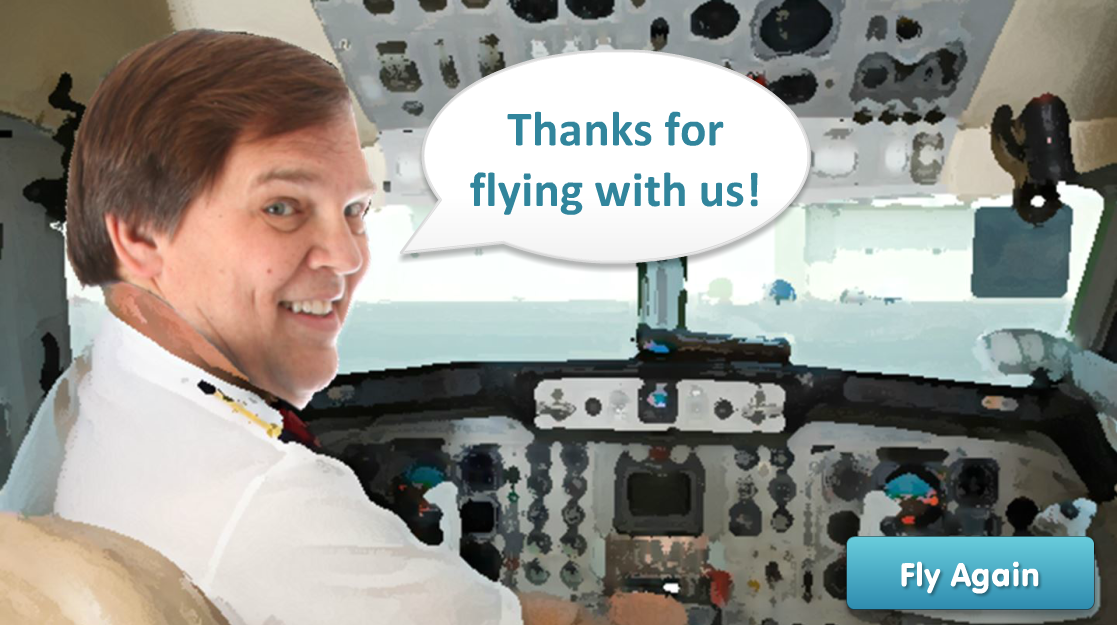
I immediately thought of airplane travel and that moment you’re in your seat watching others come down the aisle towards you as you think “Is that the person I’ll be spending the next 12 hours with, or maybe that one?” Which led me to a drag-and-drop interaction where you get to choose your seat companion based on that same lack of information, and then suffer (or enjoy) the consequences.

The interaction could easily be adapted to a real course – maybe as a predictive exercise. You could have learners choose people to perform a particular job based on whether or not they look like they have the right safety gear on, for example – then see what happens!

Your Choices

Your Choices

Building It

I built it in Storyline, but didn’t use its built-in drag-and-drop options. I just created custom triggers and used ancillary slides to show the results of each choice.

Interestingly, my biggest sticking point in construction was getting any of it to function properly as long as my drop target wasn’t visible. (You drop fellow passengers into the airplane seat next to you, but in order to isolate that drop area I used an invisible shape on top of the seat image.)

It was only after I had the vaguest recollection of seeing a video from Jeanette Brooks where she made her drop target invisible by making the fill color transparent, as opposed to choosing no fill color, that I got the thing to work. Silly me.

Select Image to Launch Demo

Select Image to Launch Demo

Enjoying the Consequences

I can’t help it. I just like this one – and you can see it right here! 

Filed Under: E-Learning Tagged With: Characters, Context, Drag & Drop, ELHChallenge, Emotional Engagement, Games, Motivation

No One Loves The “Next” Button Until It’s Gone

January 25, 2014 By Jackie Van Nice 2 Comments

Select Image to Launch Demo

Select Image to Launch Demo

I haven’t participated in many (OK – one) of the weekly design challenges that David Anderson puts out to the Articulate community, usually because of looming deadlines. But if so many other busy designers are doing it, what’s my deal? So this week, casting all current deadlines to the wind, I took up David’s gauntlet and spent my Friday night Storylining away.

This week’s Articulate challenge is based on his blog post about hiding the “next” button until the learner completes a challenge about what’s just been presented. (Or it can be used as a sort of pre-test to unlock the “next” button and allow the learner to skip ahead.)

From an instructional design perspective it would have to be used incredibly judiciously; though if sprinkled in a few key places in just the right course, it could be effective. But this challenge was about the technical aspects of building it, so that’s what I focused on.

My Example

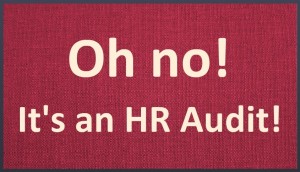
I chose the HR Audit topic because it seemed appropriately dry. I’m picturing a nodding-off learner who’s about to get a disappearing-“next”-button wake-up call.

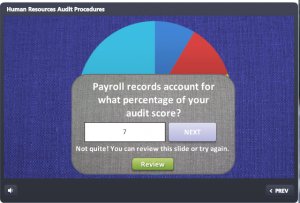
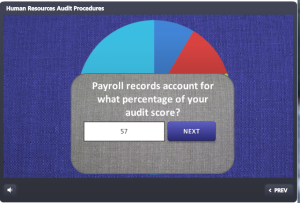
Basically, at the end of the slide I ask the learner a question about what they just saw. Then I ask them to enter a certain number they just saw. The “next” button is visible but disabled. If their answer is incorrect, they get a message asking them to try again, or to review the slide content. Once they get it right, the “next” button is enabled and they go on to their glorious reward in the final slide.

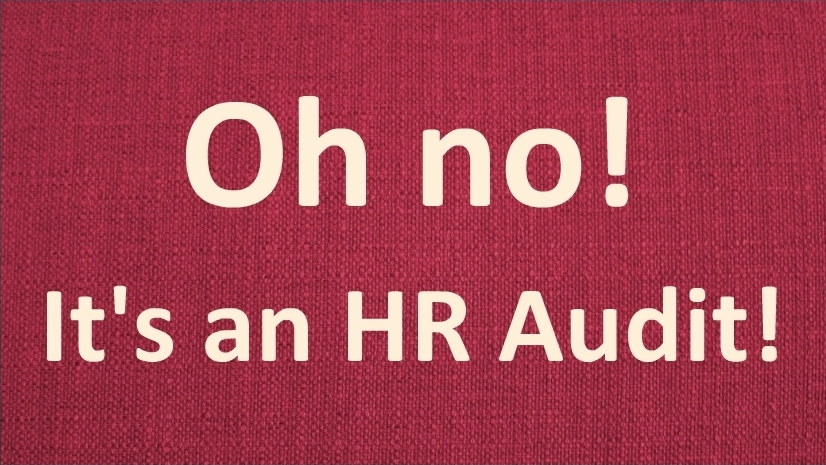
The Appropriately Dry Content

The Disabled Next Button

The Enabled Next Button

Your Glorious Reward

The Technical Side

David wanted a text-based entry field for the learner to complete in order to unlock the “next” button, so in Storyline that means adding a data entry field. I’d never had a reason to use them before, so I used a post on the E-Learning Heroes site from Jeanette Brooks that explained how to set them up. It would help to have some experience with variables, but it’s probably not necessary for the average intrepid Storyline user.

After that it was all about the layers and states and triggers. I won’t get into extreme detail, but on the main slide I added a trigger so that at the end of the timeline it would show a layer. At the end of the timeline I also animated out any potential answers on the slide so they weren’t visible.

On the layer I put the question, the data entry field, the “next” button (set to an initial state of “disabled”), a line of text feedback if the answer is incorrect (set to an initial state of “invisible”), and a “review” button so they could see the slide content again if the answer is incorrect (also set to an initial state of “invisible”.) Then I got all trigger-happy until it behaved properly.

Select Image to Launch Demo

Select Image to Launch Demo

See it Here!

Test your ability to withstand the pressure of HR Audit prep right here!

Filed Under: E-Learning Tagged With: Articulate Storyline, Context, E-Learning Design, ELHChallenge, Emotional Engagement, Instructional Design, Motivation, Show Your Work, Voiceover

  • « Go to Previous Page
  • Go to page 1
  • Go to page 2

Primary Sidebar

Welcome!

I’m an award-winning instructional designer and proud Articulate Super Hero who creates e-learning for large organizations. I blog to explain my design process, share tips and tricks, and help others succeed. I hope you enjoy my refreshing gallery of e-learning goodness!

  • View jackietrains’s profile on Instagram
  • View jackievannice’s profile on LinkedIn

Tags

Articulate 360 Articulate Rise Articulate Storyline Articulate Studio Audio Avatars CCAF Characters Community Context Design Makeover Dials Drag & Drop E-Learning Design ELHChallenge Emotional Engagement Free Download Freelancing Games German Glossary Instructional Design Languages Makeover Menu Mobile Motivation Pantone Portfolio PowerPoint Professional Development Quick Reference Quizzes Sales Training Scenarios Show Your Work Software Training Storyline 360 Tables Technical Training Templates Typography Video Visual Design Voiceover

Top Posts & Pages

  • Portfolio
    Portfolio
  • Home
    Home
  • Sexual Harassment Training
    Sexual Harassment Training
  • Sales Mobility Software Training
    Sales Mobility Software Training
  • Navigating a Tasty Circular Menu
    Navigating a Tasty Circular Menu
  • Articulate's E-Learning Heroes Challenges
    Articulate's E-Learning Heroes Challenges
  • About
    About
  • Free Visual Storyboard Template
    Free Visual Storyboard Template
  • Free Storyline Templates
    Free Storyline Templates
  • How to Go Full-Screen & Lose the Player in Storyline
    How to Go Full-Screen & Lose the Player in Storyline

Copyright © 2026 Jackie Van Nice and E-Learning Goodness by Jackie Van Nice